CamiTK: a workshop for prototyping medical applications
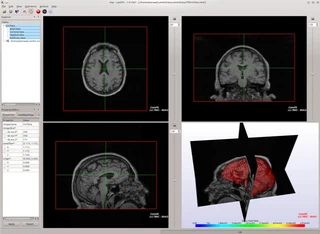 CamiTK — Computer Assisted Medical Intervention ToolKit
From software to method — capitalizing on interdisciplinary know-how to move faster, from concept to validated prototype.
Designing an application for the operating room is never “just code.” It means getting medical images, sensors, biomechanical models — sometimes a robot — and above all specialists who don’t speak the same technical language, to work together. CamiTK is the tool I co-founded with Emmanuel Promayon so that this dialogue produces prototypes — fast, clean, and reusable. It is also the foundation of expertise I now draw on to help companies prototype medical applications.
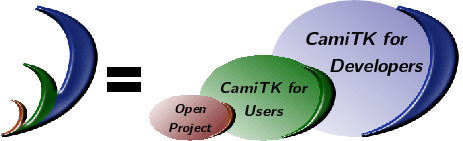
The problem: interdisciplinarity is expensive
In computer-assisted medical interventions, every team shows up with its own world: its operating system, its language of choice, its libraries, its habits — and its level of maturity, from throwaway prototype to clinical-grade software. With each new project, the temptation is to rewrite everything. You reinvent the wheel, you lose months, and the know-how walks out the door when someone leaves the team.
For a company, this is exactly the pain point: how do you avoid starting from scratch with every innovation, while keeping the rigor that medical work demands?
The answer: a shared software foundation
With Emmanuel Promayon, we designed CamiTK as a modular workshop: a stable core that handles what is common to every project — 3D visualization, interaction, data and input/output management, abstraction of medical formats (DICOM, meshes…) — and around which each specialist plugs in their own domain extension, without touching the rest.
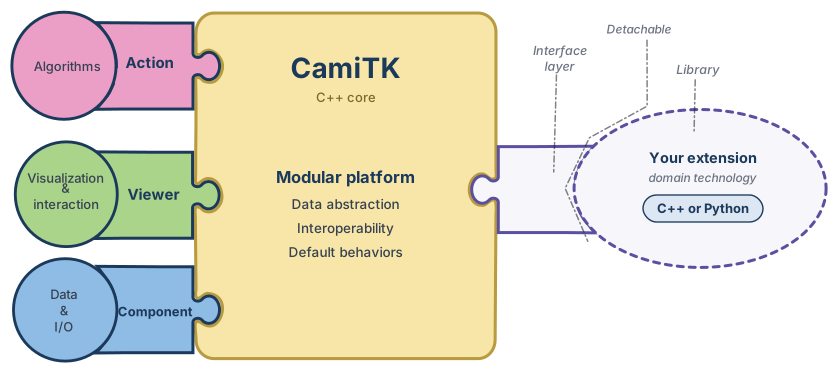
CamiTK’s building-block architecture: a shared core, an interface layer, and one extension per domain of expertise.
This architectural choice (a C++/Qt/VTK core, following component-based software engineering) delivers what a company looks for in a technical foundation. And since version 5, CamiTK also accepts Python extensions: you can prototype an idea in a few lines, then harden it in C++ once validated — exactly the right trade-off between exploration speed and production robustness.
In practice, the foundation provides:
- Cross-platform — the same code runs on Linux, Windows and macOS.
- Interoperability — the building blocks of one project are reused in the next.
- Default behaviors — a specialist plugs in their algorithm and immediately gets a working application, without rewriting the interface.
- Intellectual-property safeguards — each module keeps its own license; the open-source core coexists with proprietary extensions (as was the case for the confidential LPR modules).
- Durability — the knowledge stays in the tool, not only in people’s heads.
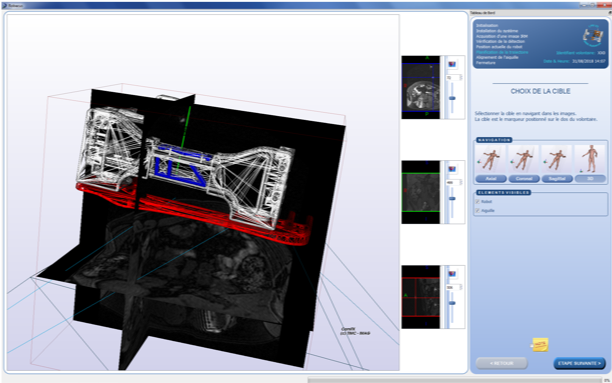
Example of an application prototyped with CamiTK.
From software building block to method
CamiTK’s most valuable contribution is not the code: it is what its practice taught us. By guiding real projects all the way to technology transfer — first among them the LPR needle-insertion robot — we generalized a methodology for maturing software building blocks for medical devices, aligned with the TRL (Technology Readiness Levels) scale.
Concretely: knowing what maturity level a prototype sits at, what it takes to reach the next one, and where to invest validation and software-quality effort so you don’t get stuck at the moment of industrial or clinical transfer. This is exactly the kind of course a company needs to hold when moving an idea from the lab to a product.
Over the projects, CamiTK thus became a dual methodological tool: to make disciplines collaborate, and to structure the climb up the TRL scale.
Adoption as proof
A method is only worth as much as its ability to outlive its authors. CamiTK has passed that test: released as open source, packaged in the official debian-med suite, adopted by internal and national projects, and — the most telling proof — still actively developed more than fifteen years after it began (version 6.0, with new tools such as DevStudio to create an extension in minutes).
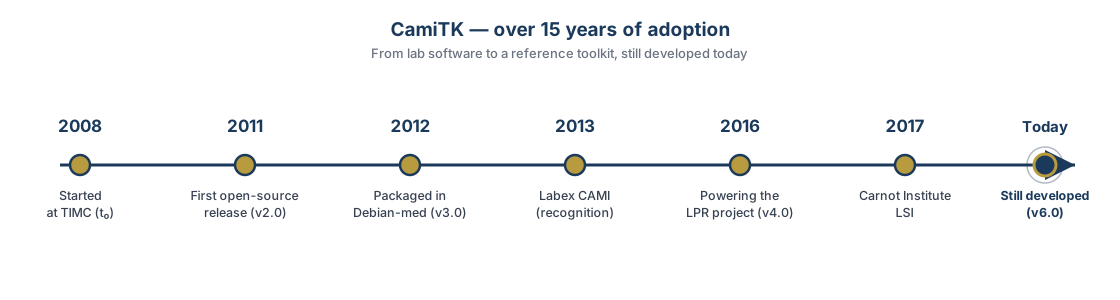
A continuous adoption trajectory, from the lab to the open-source ecosystem.
This project also gave me the chance to coordinate and co-supervise a team of engineers — up to four at once — over several years: hiring, organizing development, code review, documentation, and nurturing a community of users.
What I take from it — and what I can bring
I founded and structured CamiTK; today, I use it daily as an expert. This dual standpoint — the one who designed the architecture and the one who uses it — lets me bring to a company:
- a durable software architecture designed for reuse and cross-platform support;
- a maturity-scaling (TRL) method proven on real technology transfers;
- the ability to make very different profiles collaborate (clinical, research, engineering, industry) around a single prototype;
- fine-grained intellectual-property management in an ecosystem mixing open source and proprietary building blocks;
- the supervision of technical teams over the long term.
Publications
- 2013. Promayon Emmanuel, Fouard Céline, Deram Aurélien, Hungr Nikolaï, Luboz Vincent, Payan Yohan, Sarrazin Johan, Saubat Nicolas, Selmi Sonia Yuki, Voros Sandrine, Cinquin Philippe, Troccaz Jocelyne — Using CamiTK for Rapid Prototyping of Interactvie Computer Assisted Medical Intervention Applications. Proceedings of 35th Annual International Conference of the IEEE EMBS
- 2012. Fouard Céline, Deram Aurélien, Keraval Yannick, Promayon Emmanuel — CamiTK: a Modular Framework Integrating Visualization, Image Processing and Biomechanical Modeling. Soft Tissue Biomechanical Modeling for Computer Assisted Surgery
CamiTK is the thread that runs through all my projects, from the LPR needle-insertion robot to medical image analysis: the conviction that a good medical prototype begins with good engineering — shared, and built to last.
